
We left Coimbatore on 31st morning for Thanjavur where we had planned to stay for two days at an Airbnb home.
We had now come to take for granted that all highways in TN are eminently motorable and the stretch from Coimbatore to Thanjavur was no exception. We did miss the profusion of roadside eateries that we were so used to while driving in Maharashtra, Gujarat and Rajasthan.
It took us close to 5 hours to reach Thanjavur, the temperature rose from comfortable twenties to late thirties.
Our hostess was there to guide and greet us, when we arrived at “PAARSHEBA” their residence.

It was too hot for us to venture out in the afternoon, so we cooked ourselves some noodles in the attached kitchen, and snoozed off the afternoon heat. the Airbnb was a self contained one bedroom unit on the first floor of the bungalow, thus it offered both privacy as well as security.
Our hosts were very interesting people, Dr Paneer and his wife Mrs Rajeswari are both Academicians, Mrs Rajeshwari has retired but Dr Paneer is still active as the head of Mechanical Engg Department, in the college that he teaches.
In the evening when the temperature had cooled down sufficiently for us to venture out, we visited the famous Brihadisvara temple.
Brihadishvara Temple, also called Rajarajesvaram or Peruvudaiyar Koyil, is a Hindu temple dedicated to Shiva located in Thanjavur, Tamil Nadu, India. It is one of the largest South Indian temples and an exemplary example of a fully realized Dravidian architecture. It was Built by Raja Raja Chola I between 1003 and 1010 AD, the temple is a part of the UNESCO World Heritage Site known as the “Great Living Chola Temples”, along with the Chola dynasty era Gangaikonda Cholapuram temple and Airavatesvara temple that are about 70 kilometres (43 mi) and 40 kilometres (25 mi) to its northeast respectively.


The original monuments of this 11th century temple were built around a moat. It included gopura, the main temple, its massive tower, inscriptions, frescoes and sculptures predominantly related to Shaivism, but also of Vaishnvaism and Shaktism traditions of Hinduism. The temple was damaged in its history and some artwork is now missing. Additional mandapam and monuments were added in centuries that followed. The temple now stands amidst fortified walls that were added after the 16th century. Built out of granite, the vimana tower above the sanctum is one of the tallest in South India. The temple has a massive colonnaded prakara (corridor) and one of the largest Shiva lingas in India.
It is also famed for the quality of its sculpture, as well as being the location that commissioned the brass Nataraja – Shiva as the lord of dance, in 11th century. The complex includes shrines for Nandi, Parvati, Kartikeya, Ganesha, Sabhapati, Dakshinamurti, Chandeshvara, Varahi and others. The temple is one of the most visited tourist attractions in Tamil Nadu.
Airavatesvara Temple – Kumbakonam
The drive from Thanjavur to the Airavatesvara temple was 40 km and we started after breakfast, the temple at Airavatesvara temple was another incredible structure and it was worth braving the scorching heat just to see this temple.
The Airavatesvara temple is another square plan structure completed in 1166 CE. The surviving inner courtyard is almost six stacked squares of 35 metres (115 ft) side, measuring a total of about 107 metres (351 ft) by 70 metres (230 ft). The Nandi mandapa and the stambha are found outside of this main temple courtyard and they are aligned with the main temple’s east-west axis.
The Airavatesvara temple is one among a cluster of eighteen medieval era large Hindu temples in the Kumbakonam area. The temple is dedicated to Shiva. It also reverentially displays Vaishnavism and Shaktism traditions of Hinduism, along with the legends associated with Nayanars – the Bhakti movement saints of Shaivism.
The stone temple incorporates a chariot structure, and includes major Vedic and Puranic deities such as Indra, Agni, Varuna, Vayu, Brahma, Surya, Vishnu, Saptamtrikas, Durga, Saraswati, Sri devi (Lakshmi), Ganga, Yamuna, Subrahmanya, Ganesha, Kama, Rati and others. Shiva’s consort has a dedicated shrine called the Periya Nayaki Amman temple.


The bottom row left hand picture shows a sculpture of two four legged beasts with a common head, by covering the body of either beast, the left hand beast is shown as a bull while the beast on the right hand side is viewed as an elephant.
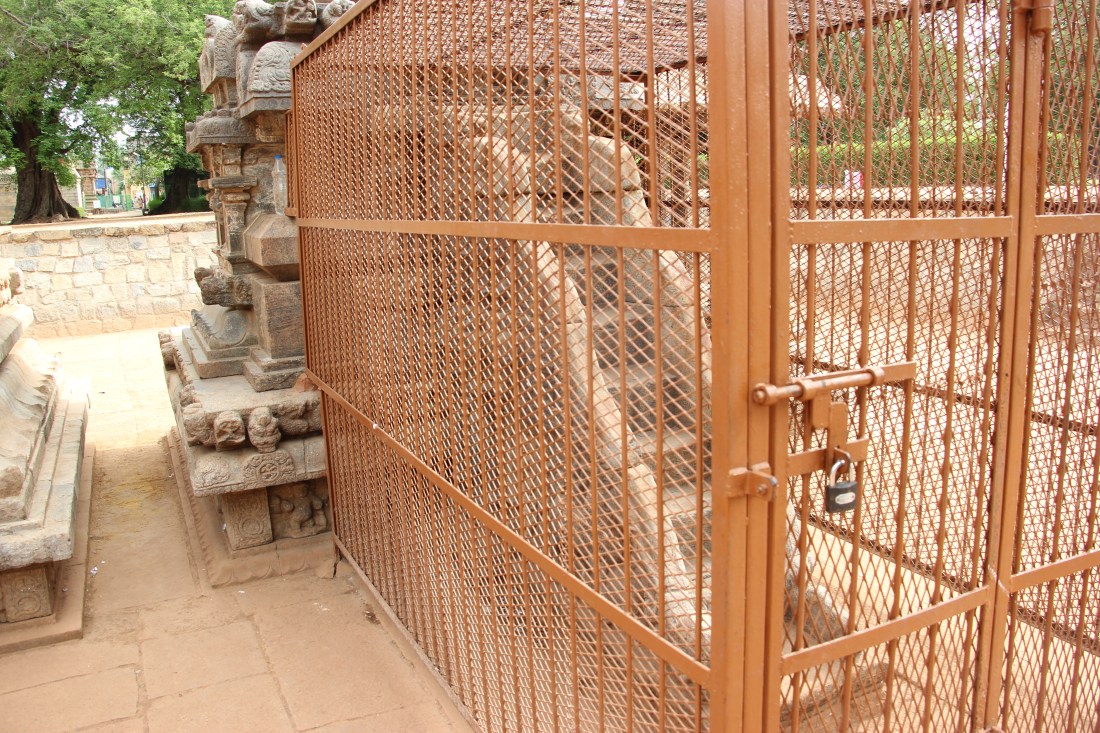
The picture above shows the famous singing steps, that have been enclosed to prevent vandalism. The steps apparently sound the seven notes when touched.
Adjoining the main temple, there is a temple dedicated to Shiva’s consort. Shiva’s consort has a dedicated shrine called the Periya Nayaki Amman temple. This is a detached temple situated to the north of the Airavatesvara temple. This might have been a part of the main temple when the outer courts were complete. At present, parts of the temple such as the gopuram is in ruins, and the main temple and associated shrines stand alone. The temple continues to attract large gatherings of Hindu pilgrims every year during Magha, while some of the images such as those of Durga and Shiva are part of special pujas.


As we were exiting the temple we were accosted by a gentleman, whom we nearly brushed off. Thank heavens we did not.
This gentleman belonged to a family that was into handloom weaving, both silk as well as cotton. This family had apparently migrated from Gujarat centuries ago, and had totally integrated with the Tamil society.
They had a loom at home that was more for display purposes, they employed other weavers in the community who worked from home and marketed their products.


Thanjavur Paintings:
No visit to Thanjavur can be complete without a mention of the distinctive school of painting. Thanjavur painting is a classical South Indian painting style, which was inaugurated from the town of Thanjavur and spread across the adjoining and geographically contiguous Tamil country. The art form draws its immediate resources and inspiration from way back about 1600 AD, a period when the Nayakas of Thanjavur under the suzerainty of the Vijayanagara Rayas encouraged art—chiefly, classical dance and music—as well as literature, both in Telugu and Tamil and painting of chiefly Hindu religious subjects in temples. It is distinguished by its famous gold coating. However, it can safely be surmised that Thanjavur painting, as we know it now, originated in the Maratha court of Thanjavur.
It is tragic that this is a dying art form. We met one of the local artists and also visited his studio/workshop, the work that goes into making these paintings is indeed incredible and skill and accuracy required need a great deal of concentration and training.
It is very important that the powers that be take an active interest to prevent this art form from extinction.


We missed the palace and art gallery, but by going by the paintings on the walls leading to the palace, we really missed something worth seeing, maybe next time.


After a very satisfying stay at Thanjavur, we move next to Rameswaram.
 Walkabout with Anil
Awesome
LikeLiked by 1 person
Superb
LikeLike
A very vivid and candid walk-thorugh Thanjavur. Interesting. Appreciate your writing and detailing skills.
Dr.R.Panneer.
LikeLike
🙏🏼 😊
LikeLike