
Rameswaram, is a town in the state of Tamil Nadu. It is on Pamban Island separated from mainland India by the Pamban channel and is about 40 kilometres from Mannar Island, Sri Lanka. It is in the Gulf of Mannar, at the tip of the Indian peninsula. Pamban Island, also known as Rameswaram Island, is connected to mainland India by the Pamban Bridge. Rameswaram is the terminus of the railway line from Chennai and Madurai. Together with Varanasi, it is considered to be one of the holiest places in India to Hindus, and part of the Char Dham pilgrimage.
It is here that Lord Rama built a bridge from here across the sea to Lanka to rescue his wife Sita from her abductor Ravana. The Ramanathaswamy Temple, dedicated to the Hindu god Shiva, is at the center of the town and is closely associated with Rama. The temple and the town are considered a holy pilgrimage site for Shaivites and Vaishnavas.
Rameswaram is the closest point from which to reach Sri Lanka from India, and geological evidence suggests that the Rama Sethu (Rama’s Bridge) was a former land connection between India and Sri Lanka.
The 237 km, scenic drive from Thanjavur to Rameswaram took, a shade over 4 hours.
Once again the TN highways did not disappoint, we however missed our elder son Aniruddh, who is serving on board a large VLCC as a shipboard engineer, he is by far the best driver amongst us, and the designated driver during “social” outings.
We booked another AirBnB stay for two nights 2nd and 3rd August, Silver Sands at Mandapam, 20 kms before the temple town of Rameswaram.
The approach to the Silver Sands resort almost puts one off, narrow roads and suicidal drivers on two wheelers and, homicidal maniacs cornering the four wheeler market. It would be unfair to brand the Mandapam alone, it has been my experience that this starts immediately after exiting the expressway before Pune and the intensity increases as we get closer to the equator.
The Silver Sands resort, is a cute resort with independent wooden cottages just across the road to a small beach. This is a small fishing hamlet, with about fifty vessels anchored in the water. Some boats were pulled up on the beach for repairs. There was also a boat under construction by a local shipbuilder.


After lunch and a short nap, we left for Dhanushkodi.
To reach Dhanushkodi we had to drive through Rameswaram, the island is linked to the mainland through the Pamban bridge, there are two bridges one railway and one road running parallel to each other.
The railway bridge is much lower and probably takes a beating during heavy weather. An usual feature of this bridge, two sections of the bridge are hinged to swivel up and allow boats to ferry to and fro across the bridge.
Another unique feature we observed, that east of the bridge the water was calm while the waters west of the bridge were turbulent.
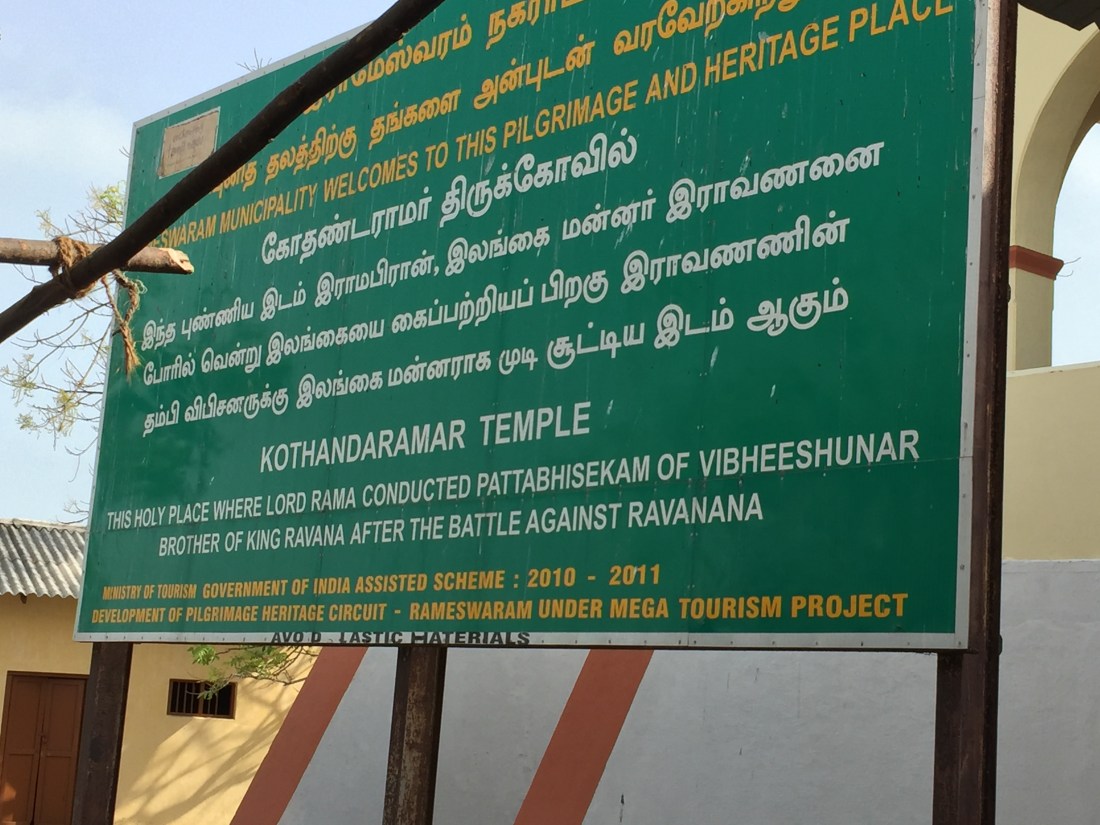
Dhanushkodi, is about 16 kms beyond Rameswaram. It is like a finger jutting into the sea between the Bay of Bengal and the Indian Ocean. Dhanushkodi is the southernmost tip of the island and houses the Kothandaramaswamy Temple dedicated to Rama. Though Dhanushkodi was washed away during the 1964 cyclone, the temple alone remained intact. It is 18 km way from the centre of the town and can be reached by road. A popular belief is that, Dhanushkodi is where Vibhishana, a brother of Ravana surrendered before Rama in the epic Ramayana.


It is also the Start of the Ram Sethu or Adam’s bridge, built by Rama’s army to invade Ravana’s Lanka.
While at Dhanuskodi, after 1600 hrs the tide started coming in, and at this point we saw a couple of fishermen launching their boat and paddling away in the distance.


On the way back we visited the Kothandaramaswamy Temple, where the crowning ceremony of Vibeeshana was carried prior the battle for Lanka and reached the temple town of Rameswaram just before sunset.
We also visited the Ramanathaswamy temple on our way back. We had to deposit the our mobiles and camera and hence we have no photographs of this magnificent temple.
Ramanathaswamy Temple
The Ramanathaswamy Temple is the most notable historic landmark of the town. Located in the centre of town, Ramanathaswamy Temple is a famous Hindu temple dedicated to the god Shiva. The temple is one of the 12 Jyotirlinga shrines, where Shiva is worshipped in the form of a Jyotirlinga meaning “pillar of light”. It is also one of the 275 Paadal Petra Sthalam temples and is glorified in hymns by the three of the most revered Nayanar saints (7th century Saivite saints), Appar, Sundarar and Tirugnana Sambandar. The temple in its current structure was built during the 12th century by Pandya Dynasty. The temple has the longest corridor among all Hindu temples in India. The breadth of these columned corridors varies from 17 to 21 feet with a height of 25 feet. Each pillar is sculpted in Nayak style as in Madurai Meenakshi Amman Temple. The contribution of the kings of the Sethupathy dynasty (17th century) to the temple was considerable. Large amount of money was spent during the tenure of Pradani Muthirulappa Pillai towards the restoration of the pagodas which were falling into ruins – the Chockattan Mantapam or the cloistered precincts of the temple was reconstructed by him. The rulers of Sri Lanka contributed to the temple – Parakrama Bahu (1153–1186 CE) was involved in the construction of the sanctum sanctorum of the temple. The eastern tower and shrine of Nataraja were built by Dalavai Sethupathy in 1649 CE. The second enclosure is ascribed to Chinna Udayar Sethupathy and his son Ragunatha Thirumalai (1500–1540 CE). The third enclosure was constructed by Muthu Ramalinga Sethupathy (1725–1771 CE) – his statue is located in the entrance of the corridor.

Temple tanks: There are sixty-four Tīrthas or Theerthams (holy water bodies) in and around Rameswaram. According to the Skanda Purana, twenty-four of them are important. Of the 24, 14 are in the form of tanks and wells within the precincts of the temple. Bathing in these tanks is a major aspect of the pilgrimage to Rameswaram and is considered equivalent to penance. Twenty-two of the tanks are within the Ramanathaswamy Temple. The foremost one is called Agni Theertham.
The Religious Significance:
Rameswaram means “One who is lord of Rama” (Ram yasy Eashwarah) in Sanskrit, an epithet of Shiva, the presiding deity of the Ramanathaswamy Temple. According to Hindu epic Ramayana, Rama, the seventh avatar of the god Vishnu, prayed to Shiva here to absolve any sins that he might have committed during his war against the demon-king Ravana in Sri Lanka. According to the Puranas (Hindu scriptures), upon the advice of sages, Rama along with his wife Sita and his brother Lakshmana, installed and worshipped the lingam (an iconic symbol of Shiva) here to expiate the sin of Brahmahatya incurred while killing of the Brahmin Ravana. To worship Shiva, Rama wanted to have a lingam and directed his monkey lieutenant Hanuman to bring it from Himalayas. Since it took longer to bring the lingam, Sita built a lingam, made of just Sands of the shores, which is also believed to be the one in the sanctum of the temple.[8] This account is well supported by the original Ramayana authored by Valmiki where it is written in yudha kanda. Sethu Karai is a place 22 km before the island of Rameswaram from where Rama is believed to have built a floating stone bridge, the Ramsethu bridge, that further continued to Dhanushkodi in Rameswaram till Talaimannar in Sri Lanka. According to another version, as quoted in Adhyatma Ramayana, Rama installed the lingam before the construction of the bridge to Lanka.
Revathi and I visited this temple again on the 3rd morning to bathe in the Theerthams or holy tanks in the temple precincts. The waters seem to have therapeutic properties as one feels invigorated after the process. However this would have been better if the planning was better and the changing rooms were better organized.
We missed not having qualified guides who could explain the history and cultural significance of the temple as well the architectural highlights.
Akshay stayed back, and explored the fishing hamlet at Mandapam.
My take on the Ramayana:
Ravana, was a brahmin and the probably the last recorded Brahmin monarch in the ancient Hindu texts.
Rama was a Kshatriya, and the Ramayana is probably the record of Kshatriya’s wresting the political power from Brahmins, as in the earlier part of Ramayana, Rama is also depicted as defeating Parashurama, who was the scourge of the Kshatriyas.
Ravana, though depicted as a villain, was chivalrous enough not to force himself on Sita, but was willing to wait for her to surrender herself willingly to him, he is probably the most romantic lovelorn “Romeo” of all times.
If Ravana was the quintessential pining Romeo, Ram was the knight in shining armor, who did not build a marble monument in memory of his lost love, but a bridge across the ocean to go and rescue his soul mate.
This is the greatest love ballad of all times, of heroic figures, of love – unrequited as well as steadfast and true, of faith that your true love will never abandon you. Even the arch villain, Ravana is a tragic and heroic even chivalrous figure, a very learned person and great devotee of Shiva, whose downfall is being besotted by Sita’s ethereal beauty, the hero Rama “the Maryada Purushottama” (perfect man) has his trying moments to be a dutiful son, loving husband, faithful friend and a righteous monarch.
This is the true appeal of the Ramayana through the ages.
 Walkabout with Anil
Fascinating place. Will visit some day
LikeLike
Very detailed information
LikeLike
😊😊
LikeLike